Rosca de Reyes in the UK: Bake It, Buy It, Drink the Chocolate
How to bake a rosca de Reyes with UK ingredients, make proper Mexican hot chocolate for 6 January, and where to shop for the pieces across Britain.
 EB
Edmond Bojalil
Recetas Mexas
In Mexico, Christmas doesn't really end on 25 December. It runs on until 6 January, Día de Reyes, when the Three Kings arrive, children find presents and the whole family gathers around a ring-shaped sweet bread and a pot of steaming chocolate. In Britain, that date falls on a grey Tuesday or Wednesday when the decorations are coming down and everyone is back at work. That makes it a good excuse to light the oven.
The rosca de Reyes is a soft, enriched dough perfumed with orange, decorated with strips of candied fruit and hiding a small figure of the baby Jesus inside. Whoever finds it in their slice has a debt to pay later in the season. It's the sort of thing that sounds complicated and turns out to be a weekend bake, especially once you know which British supermarket ingredients do the job.
This guide covers three things: how to bake a rosca with what you can find in the UK, how to make Mexican hot chocolate without a trip to Oaxaca, and where to buy the harder-to-find pieces. At the end there's a short list of Mexican restaurants across the country if you'd rather someone else did the cooking.
Why a ring of bread on 6 January?
Día de Reyes marks the Epiphany, the day the Magi are said to have reached Bethlehem. The rosca came to Mexico with the Spanish, and it's a close cousin of the roscón de Reyes that fills bakery windows here in Madrid every January. The Mexican version has its own personality: less cream filling, more decoration on top, and a very specific set of rules about the figure inside.
The symbolism is part of the fun, and it's worth explaining to guests who've never seen one. The oval or ring shape stands for a crown. The strips of candied fruit on top are its jewels. The little doll baked into the dough represents the infant Jesus, hidden from King Herod.
The rule of the muñeco
Each person cuts their own slice, so nobody can blame the host. Whoever finds the figure, the muñeco, is expected to host a tamal party on 2 February, Día de la Candelaria. In other words, the rosca sets up the next celebration. If you have a group of Mexican friends in the UK, you'll find that this rule is taken very seriously indeed.
A practical note: if children or anyone unfamiliar with the tradition is eating, tell them before cutting that there's a small hard object inside. Some families in the UK use a whole almond or a dried bean instead of a plastic figure, which is also an old custom and causes fewer dental emergencies.
Baking a rosca with UK ingredients
Our full method is in the Rosca de Reyes recipe. Here I want to focus on the swaps, because a few of the classic Mexican ingredients are either hard to find in Britain or not sold here at all.
Flour, yeast and butter
Use strong white bread flour. Its higher protein gives the rosca the stretch it needs to hold all that butter and egg without collapsing. Plain flour works, but the crumb comes out more cake-like and tears when you shape the ring.
Fast-action dried yeast from any supermarket is fine. If you can get fresh yeast from an in-store bakery counter, use it; it gives a slightly softer, more aromatic loaf. Unsalted British butter is perfect, and so are UK free-range eggs, whose deep yolks give the dough a lovely colour.
Orange blossom water
This is the scent of a good rosca. In the UK it's usually found in the world foods or baking aisle, often in Middle Eastern or Lebanese brands. Strength varies a lot between bottles, so add it a little at a time and smell the dough before adding more. Too much and the bread tastes of soap. Grated orange zest alongside it gives depth and covers any unevenness.
The candied fruit "jewels"
In Mexico the classic decoration is ate (firm fruit paste, often quince or guava), candied figs and acitrón, a candied cactus. Acitrón comes from the biznaga cactus, which is now protected, so many Mexican bakers have already moved to substitutes. You're in good company if you do the same.
- Quince paste: Spanish membrillo is easy to find in UK supermarkets and delis, especially near the cheese counter. Cut it into strips; it behaves just like ate.
- Glacé cherries: red and green ones give the traditional Christmas colours.
- Candied orange and lemon peel: buy whole pieces if you can rather than the chopped mixed peel tubs, so you can cut long strips.
- Dried figs: soften them in warm syrup and slice them; a decent stand-in for the candied version.
Between the fruit, pipe or lay strips of a sugar paste (flour, sugar, butter and egg mixed into a soft dough). It bakes into a crunchy topping, the same idea as the shell on a concha.
Proving in a British winter
The real enemy in January is a cold kitchen. Enriched doughs rise slowly, and at a chilly room temperature the first prove can take two or three hours. Put the bowl near, not on, a radiator, or in the oven with just the light switched on.
Even better, do the first rise in the fridge overnight. A cold, slow prove develops flavour and makes the dough much easier to shape the next morning. Let it warm up for about an hour before you form the ring.
Mexican hot chocolate at home
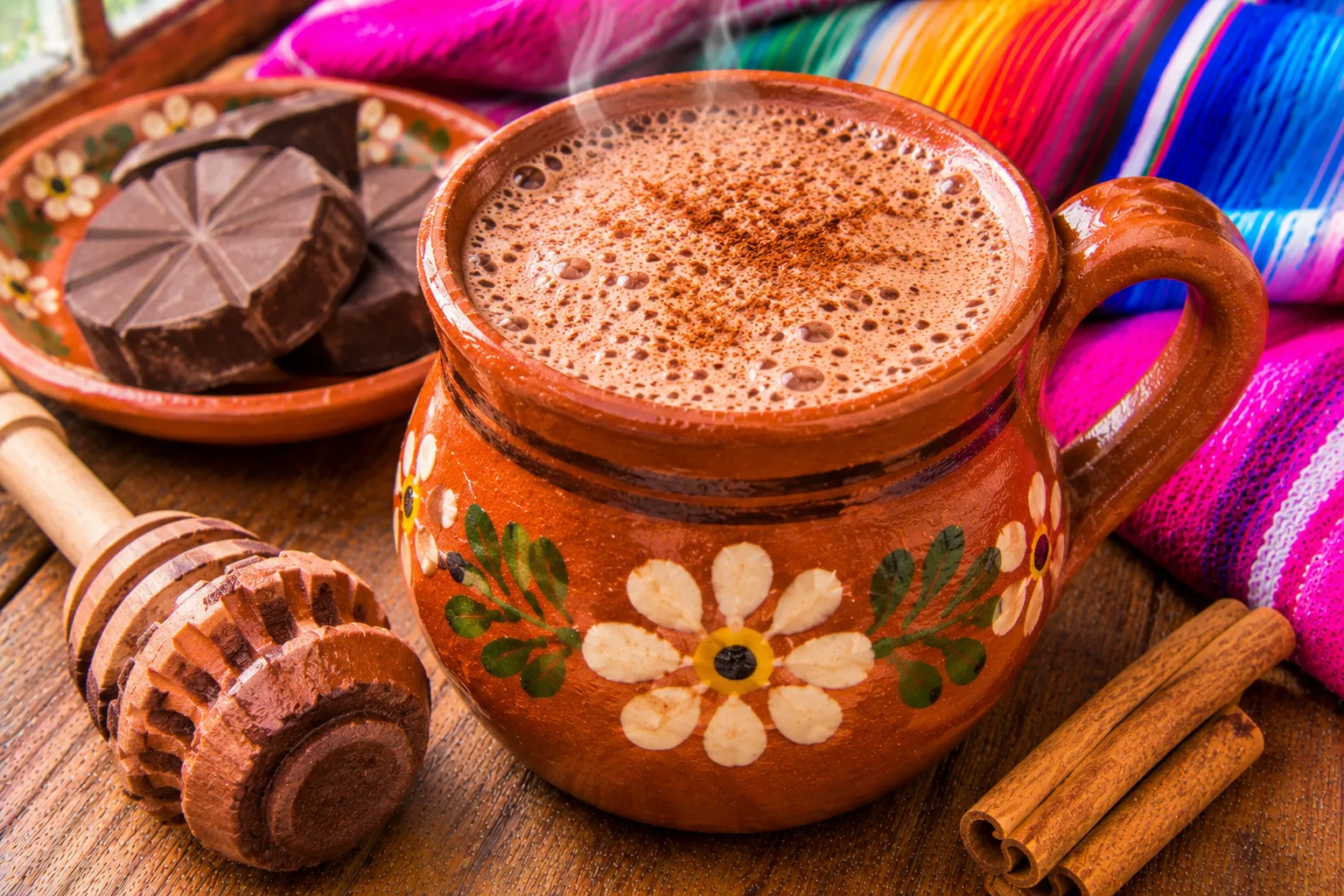
A rosca without chocolate is only half the ritual. Mexican hot chocolate is different from British drinking chocolate: it's made from tablets of roasted cacao ground with sugar and cinnamon, sometimes with almonds, and it has a slightly grainy, rustic texture. It's frothed by hand with a wooden molinillo, spun between your palms until a thick foam forms on top. The foam isn't decoration; for centuries it was considered an essential, highly prized part of the drink in Mexico, and the cup isn't finished without it.
Our Chocolate Caliente Mexicano recipe uses milk, which is how most families in central Mexico drink it at Reyes. In Oaxaca it's very often made with water, which lets the cacao taste through more clearly; for that version, see Chocolate de Agua.
If you can't find Mexican tablets
Melt a good dark chocolate (around 70 % cacao) into hot milk with a cinnamon stick, sugar to taste and a spoonful of ground almonds. Leave the cinnamon in for ten minutes, then remove it. The almonds give you some of that characteristic texture. It isn't identical, but it's very close in spirit.
No molinillo? A hand-held milk frother or a balloon whisk does the job. Froth just before serving, because the foam settles within a few minutes.
For a thicker cup
If you want something more filling for a cold night, try Atole de Chocolate, a corn-thickened drink close to champurrado. It's also the traditional partner for tamales, so keep it in mind for 2 February if the muñeco ends up in your slice.
Where to buy the pieces
Most of the rosca can be done with a regular supermarket shop. The Mexican specialists come in for the chocolate tablets, a decent cinnamon (Mexican kitchens use the soft, flaky Ceylon type, not cassia), and, if you're planning ahead for Candelaria, masa harina and corn husks for tamales. Stock changes, especially around the holidays, so check before you travel or order early enough that delivery arrives before 6 January.
These online shops send across the UK:
Mexgrocer UK
Address: Units 11 & 12 Stadium Industrial Estate, LU4 0JF
Opening hours (per our directory): Monday–Thursday: 09:00–17:00 · Friday: 09:00–16:00 · Saturday–Sunday: closed
Website: mexgrocer.co.uk
LaTiendita Online
Address: 365 New Kings Road, SW6 4RJ
Website: latienditamex.co.uk
Cool Chile Co Online
Address: 46 Westwood Park Trading Estate, Concord Road, W3 0TH
Opening hours (per our directory): Monday–Friday: 08:00–17:00 · Saturday–Sunday: closed
Website: coolchile.co.uk
Mestizo Market Online
Address: 101 Hampstead Road, NW1 3EW
Opening hours (per our directory): every day, 12:00–20:00
Website: mestizomarket.com
If you'd rather browse in person, these are some of the shops in our directory in London and beyond. In Manchester, Mercado Deli Market lists champurrado among its products, which is handy if you want to taste the real thing before making your own.
| # | Name | Address | Google (reviews) |
|---|---|---|---|
| 1 | Mexican Mama | 232 Rye Lane, SE15 4NL | – |
| 2 | La Marketa | Ground Floor 180-188 Camden High Street, NW1 8QP | – |
| 3 | Cool Chile Co | 8 Southwark Street, SE1 1TL | – |
| 4 | Latin Market Brixton Village | Unit 93, Brixton Village, Coldharbour Lane, SW9 8PS | – |
| 5 | DistriAndina Seven Sisters | 266-268 High Road, N15 4AJ | – |
| 6 | Mercado Deli Market | 192A Burton Road, West Didsbury, M20 1LH | – |
| 7 | Lupe Pintos Edinburgh | 24 Leven Street, EH3 9LJ | – |
| 8 | Lupe Pintos Glasgow | 313 Great Western Road, G4 9HR | 4.8 (293) |
| 9 | Morales Latin Market | 70 Stokes Croft, BS1 3QY | – |
| 10 | Weigh To Go | 27 Crighton Place, EH7 4NY | – |
Our directory currently lists 242 Mexican and Latin American shops across the UK, so it's worth looking up your own city too.
Para seguir leyendo: Mexican Ingredients in Stockport: Where to Shop and What to Buy.
Thinking ahead: tamales for Candelaria
Since the rosca leaves someone with a party to host, it makes sense to plan for it. Tamales freeze well, so you can make a batch in January and steam them on the day. Start with our Masa para Tamales, then choose a filling. Tamales de Mole Poblano are a classic for a celebration, and sweet ones like Tamales de Chocolate go down very well with anyone who loved the hot chocolate.
Eating Mexican food in the UK in January
None of the restaurants below list a rosca in our directory, so don't assume you'll find one on the menu. But if you want a Mexican meal around Reyes, or you're too busy to cook, these are some of the places in our directory across different cities. Our directory includes 374 Mexican restaurants in the UK in total.
| # | Name | Address | Google (reviews) |
|---|---|---|---|
| 1 | Mestizo Mexican Restaurant & Tequila Bar | 103 Hampstead Rd, London NW1 3EL | 4.6 (9,780) |
| 2 | Miros Cantina Mexicana | 184 Rose St, Edinburgh EH2 4BA | 4.2 (1,301) |
| 3 | Lupe's Cantina | 204 Cardigan Rd, Burley, Leeds LS6 1LF | 4.7 (1,339) |
| 4 | Amigos | 617 London Rd, Heeley, Sheffield S2 4HT | 4.2 (1,208) |
| 5 | La Parrilla Mexican Tapas Bar & Grill | 57 Bold St, Liverpool L1 4EU | 4.3 (1,135) |
| 6 | Halisco | 64 Preston St, Brighton and Hove, Brighton BN1 2HE | 4.4 (907) |
| 7 | Taco Nopal | 23 Promenade, Cheltenham GL50 1LE | 4.7 (721) |
| 8 | Chucho's The Real Mexican Food | 279 Shields Rd, Newcastle upon Tyne NE6 1DQ | 4.8 (966) |
Opening times often change over the festive period, and if any listing shows unusually long hours, it's sensible to confirm with the restaurant before you go.
Frequently asked questions
Can I make the rosca a day ahead?
Yes. Bake it the day before, let it cool completely and wrap it well. To refresh it, warm it in a low oven for about ten minutes. Alternatively, make the dough the night before and leave it to prove slowly in the fridge.
What can I use instead of acitrón?
Quince paste, candied orange peel, glacé cherries and softened dried figs all work. Many bakers in Mexico have already switched to substitutes because the biznaga cactus used for acitrón is protected.
Is Mexican hot chocolate the same as Spanish chocolate a la taza?
No. Spanish chocolate a la taza is thickened and very dense, ideal for dipping churros. Mexican hot chocolate is thinner, flavoured with cinnamon and frothed until foamy. If you want the churro experience, our Churros con Chocolate Caliente recipe covers it.
What happens if I find the muñeco?
Tradition says you host the tamales on 2 February, Día de la Candelaria. Some families also make you the godparent of the baby Jesus figure from the nativity scene for the year.
Can I order Mexican chocolate online in time for 6 January?
Usually yes, but order in December. Courier services are slower over Christmas and New Year, and specialist shops can run low on seasonal items.
Sources
- Business data: RecetasMexas directory (United Kingdom): name, address, opening hours, Google rating and review count, and menu where available, checked on 16 November 2026.
- Diana Kennedy, The Essential Cuisines of Mexico
- Ricardo Muñoz Zurita, Diccionario enciclopédico de gastronomía mexicana
- Sophie D. Coe and Michael D. Coe, The True History of Chocolate

Founder, Recetas Mexas
Mexican from Puebla, IT professional and foodie. Author of 1000+ authentic Mexican recipes adapted for home kitchens worldwide. Based in Madrid since 2018.
Read more