Squash blossom: what it is, its season and how to clean it

Edmond Bojalil · Founder, Recetas Mexas
Updated: 2 Sept 2026

What is it?
Squash blossom is the edible inflorescence of plants of the genus Cucurbita (mainly Cucurbita pepo and Cucurbita moschata), domesticated in Mesoamerica more than 8,000 years ago. It is distinguished by its orange or intense yellow petals, its velvety texture and a delicate, herbaceous and slightly sweet flavour. In Mexican cooking it is an essential ingredient of quesadillas, soups, crêpes, esquites, tamales, rajas with blossom and regional stews. The main season runs from May to September, coinciding with the summer rains. It is harvested early in the morning, before the flowers close in the heat of the day. It is produced in the milpa system (maize, beans, squash) in states such as the State of Mexico, Puebla, Tlaxcala, Morelos, Oaxaca, Veracruz and Michoacán, where its gathering and sale in traditional markets remains predominantly the work of women, perpetuating farming knowledge passed down for generations.
Origin and history
The consumption of squash blossom is documented from the Mesoamerican Formative period, with archaeobotanical evidence in the caves of Tehuacán, Puebla, and in Guilá Naquitz, Oaxaca, according to research by the archaeologist Kent Flannery and the Smithsonian. It forms part of the milpa, a farming system declared agri-food heritage by SADER and recognised by the FAO as one of the Globally Important Agricultural Heritage Systems (GIAHS). Friar Bernardino de Sahagún, in the Florentine Codex, describes the use of ayoxóchitl flowers as food and as a ritual offering. The Mexican government documents its traditional sale in Mexica tianguis such as that of Tlatelolco. Larousse Cocina and México Desconocido agree that squash blossom is one of the most representative ingredients of the ritual and everyday cooking of the Central Highlands, linked to patron-saint feasts and agricultural ceremonies such as the blessing of the seeds at Candlemas and the rituals of the Señor del Cerrito in Puebla.
Characteristic ingredients
The squash produces male flowers (without fruit, on a long stem) and female ones (with a small incipient fruit at the base). For consumption the male ones are preferred, more abundant and longer, since the plant can do without them without affecting the harvest. After gathering at dawn, they must be processed quickly: sepals and pistils are removed and they are cleaned with a damp cloth. Their flavour is very delicate and vegetal, with notes of young artichoke, asparagus and butter; when cooked in butter with onion and serrano chilli they release sweetness and umami. In Mexican cooking they are prepared: sautéed with epazote for quesadillas, in cream soups with sweetcorn and poblano chilli, in empanadas, as a tamal filling with cheese, in crêpes with huitlacoche, in Puebla rajas, in white rice with blossom, and as a garnish for fish. They provide vitamins A and C, iron, phosphorus and antioxidants, according to bromatological studies by UNAM. In contemporary cooking, chefs such as Patricia Quintana and Margarita Carrillo have brought it into fine dining with stuffing and tempura techniques.
Cultural significance
Squash blossom is one of the vegetable symbols of Traditional Mexican Cuisine, inscribed by UNESCO as Intangible Cultural Heritage in 2010, a central part of the milpa and of the Mesoamerican dietary paradigm based on maize-beans-squash. Socio-economically, its gathering and sale in markets such as La Merced (Mexico City), Atlixco (Puebla) and La Cuevita (Iztapalapa) sustains thousands of farming families, mainly women gatherers. Festivals such as the Squash Blossom Fair in Xochimilco and Tlaxcala celebrate its gastronomic and agricultural importance. The FAO has recognised the Mexican milpa as a GIAHS, highlighting the associated cultivation where the maize provides support, the beans fix nitrogen and the squash carpets the ground preventing weeds. Research by Chapingo and INIFAP studies landrace varieties to preserve germplasm and agroecological practices. Contemporary restaurants such as Pujol, Quintonil and Sud 777 include the blossom on seasonal menus, reinforcing its value as an identity product and dietary biodiversity.
Related recipes
Now that you know what it is, try cooking it at home with our step-by-step recipes:
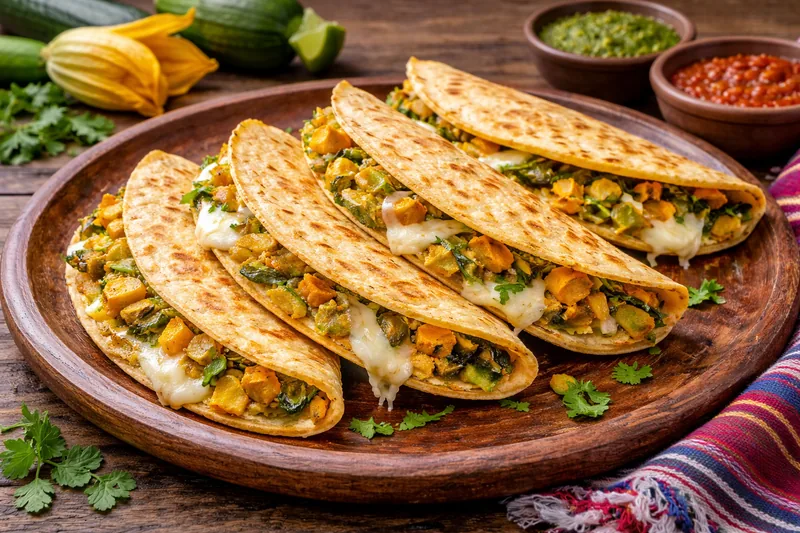

Ingredients to cook it
Find where to buy authentic ingredients in Mexican shops in the US:
Frequently asked questions
- What does squash blossom taste like?
- Squash blossom has a delicate, vegetal flavour, with notes of young artichoke, asparagus, romaine lettuce and a slightly sweet, buttery base. When cooked with onion and epazote, its herbaceous profile intensifies and releases sweetness. Its texture is velvety when briefly sautéed, and crisp when prepared in tempura or battered with egg.
- How is squash blossom cleaned?
- The green sepals at the base are removed with the fingers, the yellow pistil in the centre is discarded (some cooks leave it in), they are carefully rinsed under cold water and dried with a soft cloth. It is important to process them in the hours following the harvest, since they wilt quickly and lose their freshness and characteristic aroma.
- What is the season for squash blossom in Mexico?
- The main season runs from May to September, coinciding with the summer rains when the milpa squash flowers abundantly. It is harvested at dawn, before the flowers close in the heat of the day. Some semi-early varieties and greenhouse crops make it available all year round in urban markets.
- Where does squash blossom come from?
- It is native to Mesoamerica, where squash was domesticated more than 8,000 years ago in caves of Oaxaca and Puebla. Its pre-Hispanic consumption is documented by Sahagún in the 16th century. Today it is grown mainly in the State of Mexico, Puebla, Tlaxcala, Morelos, Oaxaca, Veracruz and Michoacán, within the traditional milpa system declared a GIAHS.
Sources
- Flor de calabaza - Larousse Cocina
- Flor de calabaza, ingrediente prehispánico - México Desconocido
- Calabaza mexicana - gob.mx SADER
- Milpa SIPAM - FAO Patrimonio Agrícola
Founder, Recetas Mexas
Mexican from Puebla, IT professional and foodie. Author of 1000+ authentic Mexican recipes adapted for home kitchens worldwide. Based in Madrid since 2018.
Read moreEnjoyed this?
Follow on TikTok for Mexican recipe & restaurant videos, and get updates by email.