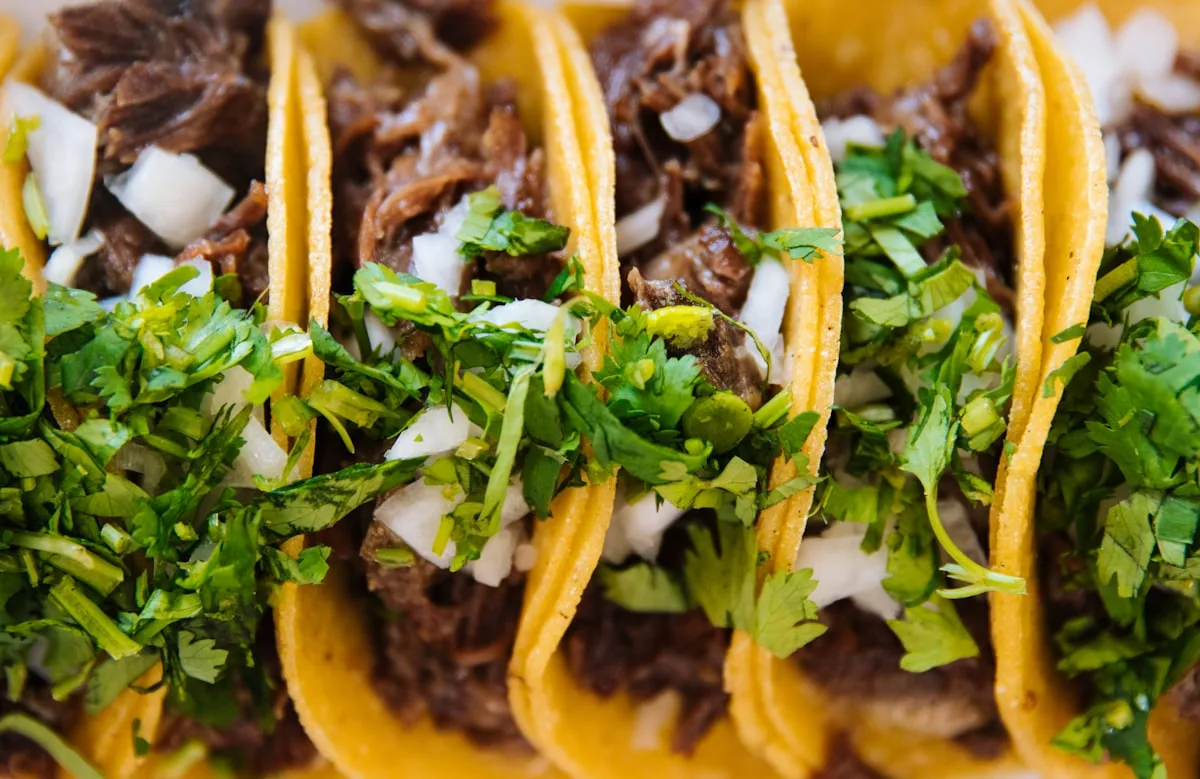
What to Order at a Taqueria Without Guessing: The Meat and Cut Glossary
Al pastor, suadero, maciza, campechano: nineteen words that decide what lands on your plate, how the order is actually placed, and the salsa sequence.
There is a specific kind of paralysis that happens at a taqueria counter. The board lists eight or ten words, none of them translated, the queue is moving, and the safe option is to say the one word you recognise. People order al pastor for years for this reason, and al pastor is excellent, but it is one item on a list that was written for people who already know the rest.
This is that list. We have a separate glossary of antojitos, which covers the formats: sopes, huaraches, tlacoyos, gorditas, quesadillas. This one is only about what goes inside, which is the part that stops people, and about how the order is placed.
The glossary
| Word | What it is | What to expect |
|---|---|---|
| Al pastor | Pork marinated in a chilli and achiote adobo, stacked on a vertical spit called a trompo and shaved off as it cooks | Red-edged, slightly sweet, usually served with a sliver of grilled pineapple from the top of the spit. The benchmark order. Our recipe is the home version. |
| Suadero | A thin cut from between the belly and the leg of the cow, simmered then confited in its own fat | Soft, rich, faintly gelatinous, nothing like a grilled steak. The Mexico City taco. Recipe here. |
| Maciza | Lean muscle meat, usually pork, from the carnitas pot | The default choice if you want carnitas without any of the offal or fat cuts. Firm and shreddy. |
| Carnitas | Pork slow-cooked in lard until it falls apart, then crisped | Ordered by part, not just by name: maciza, cuerito, costilla, buche. Michoacan-style recipe. |
| Cuerito | Pork skin, cooked soft rather than crisp | Yielding and gelatinous. Often ordered mixed with maciza for contrast. |
| Chicharron | Fried pork skin; as a taco filling usually chicharron prensado, pressed and stewed in salsa | The pressed version is soft and intensely savoury, not crunchy. If you want crunch, that is chicharron eaten as a snack. |
| Buche | Pork oesophagus | Chewy in a specific springy way that people either love or quietly do not order again. |
| Tripa | Small intestine, cleaned and then fried long and hard on the plancha | Crisp at the edges, rich in the middle. One of the great tacos when the cook is good and genuinely unpleasant when they are not. |
| Lengua | Beef tongue, poached, peeled and diced | Dense, mild, almost buttery; the gateway offal. Tongue in green salsa is the home route. |
| Cabeza | Steamed beef or pork head meat, served as a whole or by part | Sub-cuts you may see listed separately: cachete (cheek), ojo (eye), trompa (snout), nana or nenepil (uterus). Cachete is the easiest and arguably the best. |
| Barbacoa | Lamb or mutton, wrapped in maguey leaves and cooked slowly in a pit or a steamer | A weekend institution, usually sold until it runs out. Comes with consome, the broth from the bottom of the pot. Beef version. |
| Birria | Goat, or now commonly beef, stewed in a chilli adobo until it shreds | The version that travelled worldwide is the quesabirria, griddled with cheese and dipped in the consome. Recipe. |
| Longaniza | A long, finely minced fresh sausage, redder and softer than chorizo | Cooked on the plancha until it breaks up. Often paired with al pastor in a campechano. |
| Chorizo | Fresh Mexican chorizo: raw minced pork with chillies and vinegar, crumbled and fried | Not the Spanish cured sausage, which cannot be substituted here. |
| Cecina | Thin salted, air-dried beef, grilled fast | Chewy and deeply savoury. Enchilada cecina is the chilli-rubbed version, and the word enchilada here means chillied, not the baked dish. |
| Arrachera | Skirt or flank steak, marinated and grilled | The northern Mexican taqueria cut, and the one a British diner will find most familiar. |
| Campechano | Not a cut: a mix, usually two or three of the above on one tortilla | Typically beef and chorizo with chicharron, but every counter mixes its own. Ask what goes in theirs. |
| Pescado and camaron | Battered or grilled fish, and prawns | The coastal tradition, Baja and Sinaloa. Served with shredded cabbage and a thin creamy sauce rather than onion and coriander. |
| Nopal | Prickly pear cactus paddle, grilled or stewed | Tart and slightly mucilaginous, like a cross between green beans and sorrel. Usually a side or a vegetarian filling. |
Campechano is a combination, which is the point people miss
Readers ask us which animal campechano comes from with some regularity, and the answer is that the word describes a blend rather than a part. It comes from the idea of mixing, and what gets mixed is the taquero's decision. In Mexico City a campechano often means suadero with chorizo and a scatter of chicharron prensado; in the north it may be arrachera with something else. If a menu lists it without explanation, asking is normal and expected, not a sign of ignorance.
How the order is actually placed
At a counter in Mexico the exchange is short and the shape of it is always the same: how many, of what, and with what on them. Tacos are ordered by the piece, which is why four or five is a normal order and one is a strange one. The useful phrases, in rough order of usefulness:
- Con todo means with everything, which on a street taco means chopped onion and coriander. It does not mean every topping in the building.
- Sin cebolla leaves the onion off, and the same construction works for the coriander. There is no shame in either, and coriander aversion is genetic rather than fussiness.
- Con queso adds cheese, which at some counters means a griddled crust of it and at others a sprinkle.
- Doblado or dorado means folded and crisped on the plancha rather than served soft.
- Para llevar is to take away, and it changes how the tortillas are packed so they do not steam into mush.
The tortillas are usually doubled. This is not generosity, it is engineering: a single maize tortilla will not survive a wet filling, and the second one is there to be sacrificed. Taking the bottom one off and leaving it on the plate is entirely normal.
The salsa sequence
Salsas arrive in bowls and nobody tells you which is which, because the convention is that you find out. Two habits make this painless. First, the colour tells you less than you think: a green salsa can be raw and sharp or hot enough to ruin your evening, and a red one is not reliably hotter than a green one. Second, apply a drop to the edge of the first taco rather than the whole thing, and work up. The order that causes least regret is: taste, then dress one taco, then dress the rest.
Alongside the salsas you will often find pickled onions, pickled jalapenos and carrots, grilled spring onions, lime wedges, and sometimes a bowl of frijoles or a thin consome. Limes are not optional decoration; the acid is doing a structural job against the fat.
What a British taqueria will and will not have
Of the nineteen words above, a UK menu will reliably carry al pastor, carnitas, barbacoa, birria, chorizo, arrachera, chicken, prawn and fish, and some form of vegetarian filling with beans, mushrooms or cauliflower. Lengua and cabeza appear at a handful of places. Tripa, buche and nana are rare, because the supply chain for well-cleaned offal in small quantities is genuinely difficult here and because a kitchen will not put a dish on a menu it cannot sell out of.
That is not a complaint about British taquerias. The ones we have mapped cook within the supply they have, and the better ones are specific about it rather than pretending. If you want to know what is near you, the restaurant directory lists the Mexican places we have mapped across the UK, with addresses and, where Google publishes one, a rating. We map them; we do not score them.
The etiquette, briefly
Tacos are eaten with hands, standing up if that is what the place offers, and quickly. Leaning forward over the plate is the correct posture and not bad manners. A taco is not designed to be put down halfway through. If there is a consome, it is drunk between tacos rather than at the end. And the second order is normal: the first round at a counter is a tasting round, and the taquero expects you to come back and ask for two more of whichever one you liked.
Common questions
What should a first-timer order?
Al pastor and one other thing. The second item is where the information is, and suadero or cachete are the two that teach you the most about what the kitchen can do.
Is it rude to ask what a word means?
No. Mexican counter staff explain cuts all day to Mexican customers, because regional vocabulary varies within Mexico too.
Why are my tacos served with two tortillas?
Structural support for a wet filling. Eat it as one, or discard the lower tortilla; both are normal.

Founder, Recetas Mexas
Mexican from Puebla, IT professional and foodie. Author of 1000+ authentic Mexican recipes adapted for home kitchens worldwide. Based in Madrid since 2018.
Read more