Sopa azteca: what tortilla soup is and how to make it

Edmond Bojalil · Founder, Recetas Mexas
Updated: 10 Sept 2026
What is it?
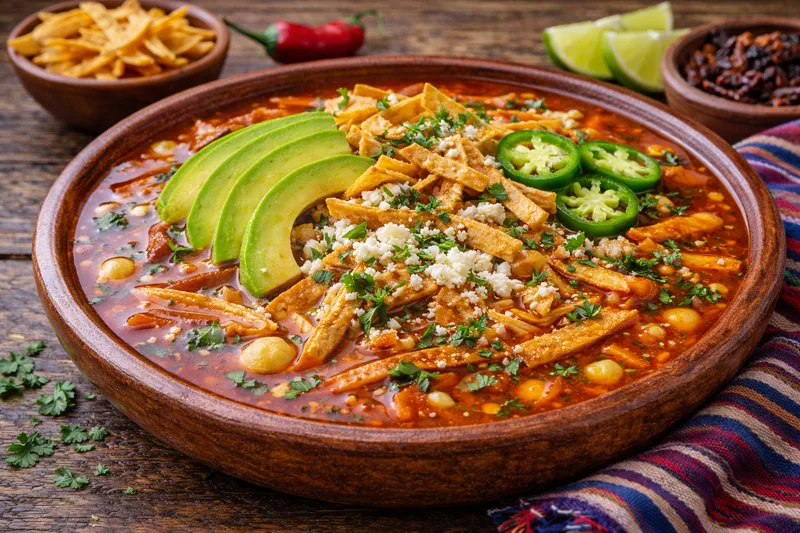
Sopa azteca, also called tortilla soup, is one of the most iconic soups of Mexican gastronomy. Its base is a broth of roasted tomato with onion, garlic and epazote, to which fried, chopped pasilla chilli is added. It is served with strips of fried or toasted maize tortilla, diced avocado, panela or fresh cheese, cream and, in some versions, pork crackling. It is a soup that combines crunchy and creamy textures, smoky and fresh flavours, and is an emblematic dish of both the 'comida corrida' and Mexican fine dining. Larousse Cocina, Pati Jinich and Recetas Nestlé document it as an indispensable soup of the Valley of Mexico and Tlaxcala. It appears on the menus of Mexican restaurants around the world and is probably the most exported soup of the national repertoire, after pozole.
Origin and history
Sopa azteca is an heir of the pre-Hispanic traditions of using tomato, chilli, maize and epazote, basic ingredients of the milpa system. Although there is no record of a 'sopa azteca' as such in colonial sources (Fray Bernardino de Sahagún does not mention it in his Historia general de las cosas de la Nueva España), the combination of ground tomato with toasted or fresh tortillas and chillies appears in nineteenth-century recipe books. Larousse Cocina notes that the recipe became established in the twentieth century, possibly in Tlaxcala - where it is made with pasilla chilli and called 'sopa tlaxcalteca' - or in Mexico City. The name 'azteca' is commercial and romantic, not historical: it arose in the mid-twentieth century to evoke the Mexica heritage of the ingredients. Chefs such as Yuri de Gortari and María Dolores Torres Yzábal have documented it in their books as an example of the mestizo cuisine of the highlands. Pati Jinich includes it in her book Pati's Mexican Table as an indispensable soup.
Characteristic ingredients
The base broth is made by roasting tomato, onion and garlic on the comal until they are blackened on the outside, then they are blended and strained. They are poured over a hot pan with oil in which strips of dried pasilla chilli were previously fried —that long, dark chilli of moderate heat and sweet raisin-like notes. Chicken broth and epazote are added. The maize tortillas are cut into julienne, fried in hot oil until golden and crisp, and added at the moment of serving so that they keep their texture. The cheese used is panela or crumbly fresh cheese; in modern versions grated Oaxaca cheese is used so that it melts. The avocado goes in large cubes and the cream is drizzled in a thin stream. Some Tlaxcalan versions include crumbled pork crackling. Excélsior and Pati Jinich agree that the secret is not to mix everything together: each element is assembled when serving to preserve textures. The heat of the pasilla can be modulated by removing its seeds.
Cultural significance
Sopa azteca is one of the gastronomic ambassadors of Mexico in the world: it appears in Mexican restaurants in Madrid, New York, Tokyo and Buenos Aires as a signature starter. In Tlaxcala it is considered an identity dish and there is a regional variant named 'sopa tlaxcalteca' or 'Tlaxcalan tortilla soup' that some cooks defend as the original. The 2010 UNESCO declaration of traditional Mexican cuisine includes the principles that underpin this dish: the milpa-maize-chilli combination, mestizo roasting and grinding techniques, the use of dried chillies. Sopa azteca is also a favourite Lenten and vigil dish because it does not necessarily carry meat: only the broth, the tortilla and the dairy. Chefs such as Enrique Olvera, Patricia Quintana and Pati Jinich have brought it to international television and books. The pre-packaged fried tortilla industry —brands such as Tostitos, Donas, Sabritas— benefits from its popularity. Restaurants such as Café Tacuba in CDMX and Tierra y Cielo in San Cristóbal de las Casas include it on their menus as a reference.
Related recipes
Now that you know what it is, try cooking it at home with our step-by-step recipes:

Ingredients to cook it
Find where to buy authentic ingredients in Mexican shops in the US:
Frequently asked questions
- What is the difference between sopa azteca and tortilla soup?
- They are basically the same dish with two names. 'Sopa azteca' is the popular commercial name that evokes the pre-Hispanic heritage; 'tortilla soup' is the descriptive term most used in homes. Some cooks call sopa azteca only the version with melted cheese in the centre, and 'tortilla soup' the dry version with crisp tortilla when serving. In Tlaxcala it is also called sopa tlaxcalteca.
- What does sopa azteca taste like?
- It tastes of deep roasted tomato with smoky notes from the pasilla chilli —sweet, earthy, slightly spicy. The cream and the panela cheese provide smoothness, the avocado freshness, the crisp tortilla strips texture and a toasted maize touch. The epazote adds its characteristic herbal profile. It is a balanced soup: creamy, smoky, crunchy and refreshing at the same time.
- How is sopa azteca served?
- It is served hot in a deep bowl or clay pot. At the bottom are placed strips of fried tortilla, diced avocado, panela cheese and optionally crackling. The very hot tomato broth is poured so that the tortillas gradually soften while keeping some crunch. On top it is garnished with strips of fried pasilla chilli, drizzled cream and extra fresh cheese.
- Where does sopa azteca come from?
- It is native to central Mexico, with two focuses: Tlaxcala —where it is known as sopa tlaxcalteca and considered an identity dish— and Mexico City, where it became popular as sopa azteca in twentieth-century restaurants. Its origin mixes pre-Hispanic ingredients (tomato, chilli, epazote, tortilla) with colonial techniques (roasting, frying) in a modern mestizo creation.
Sources
Founder, Recetas Mexas
Mexican from Puebla, IT professional and foodie. Author of 1000+ authentic Mexican recipes adapted for home kitchens worldwide. Based in Madrid since 2018.
Read moreEnjoyed this?
Follow on TikTok for Mexican recipe & restaurant videos, and get updates by email.