Tlacoyos: what they are, fillings and how to make them

Edmond Bojalil · Founder, Recetas Mexas
Updated: 10 Sept 2026

What is it?
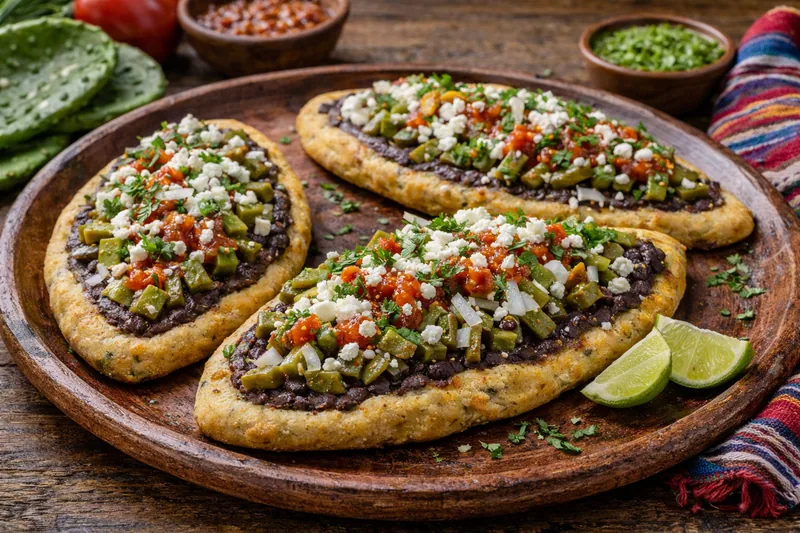
Tlacoyos are one of the oldest antojitos of the Mexican repertoire and represent a living manifestation of pre-Hispanic cooking. They are made with nixtamalised maize masa - ideally blue, purple or speckled maize, although it can also be white - shaped into an elongated oval form (10-15 cm long by 5-7 cm wide), stuffed from the raw masa with a dry filling: cooked dried broad bean paste, ground refried black or pinto bean, curd cheese with epazote, or pressed chicharrón. They are cooked on a clay or metal comal until the masa is cooked and the filling is heated. They are served hot with green or red salsa, grilled nopales, crumbled fresh cheese, cream and chopped onion. Larousse Cocina, Pati Jinich and México Desconocido document them as representative antojitos of the highland repertoire - State of Mexico, Mexico City, Hidalgo, Tlaxcala and Puebla. Their cultural value is intensified by the use of blue maize, a native variety under threat but defended by food-sovereignty initiatives.
Origin and history
Tlacoyos are undoubtedly pre-Hispanic. The original Nahuatl word 'tlatlaoyo' means 'that which is cooked on stone' or 'thick stuffed tortilla', and is documented by Fray Bernardino de Sahagún in his General History of the Things of New Spain (sixteenth century), where he describes Mexica cooks preparing similar antojitos for the Tlatelolco market. México Desconocido notes that tlacoyos were an everyday food of the pre-Hispanic popular classes, while the nobility consumed more elaborate variants with fillings of quail, turkey meat or frogs. The elongated oval shape of the tlacoyos is original pre-Hispanic: the word 'tlacoyalli' means 'oval or elongated thing' in Nahuatl. After the conquest, the tlacoyo survived as a popular antojito and was enriched with European ingredients: the bean - which although American had its cultivation intensified - and fresh cheese as an accompaniment. The industrialisation of nixtamalised maize kept tlacoyos going but using white flour; the use of blue maize as the main ingredient has been recovered since the 2000s thanks to gastronomic revival movements led by chefs such as Carmen Titita Ramírez Degollado, Yuri de Gortari and Edith Kwap.
Characteristic ingredients
The optimal masa is of blue, purple or speckled nixtamalised maize, freshly ground on a metate or hand mill, ideally from native maizes such as the blue conical maize of Hidalgo or the speckled bolita of Tlaxcala. If maize flour is used, Maseca has a blue version ('Harina de Maíz Azul Maseca') that reproduces the colour and part of the flavour. The masa is hydrated with water and salt until it reaches a firm but pliable consistency. The most common traditional filling is peeled dried broad beans cooked until they become a paste, or refried black beans ground until they form a dry paste. Curd cheese with epazote, pressed chicharrón or fresh cheese are also used. A ball of masa of 60-80 g is formed, lightly flattened, the filling is placed in the centre, it is closed and modelled into an elongated, flat oval shape. It is cooked on a hot comal without fat on both sides for 4-6 minutes per side, turning once so it browns evenly. Some stalls finish it on a griddle with a little oil for greater browning. Pati Jinich describes regional variants: tlacoyos of the Coyoacán market (Mexico City) with broad-bean filling; Hidalgo tlacoyos with speckled maize; vegan tlacoyos with broad bean and nopales in her Pati's Mexican Table recipe.
Cultural significance
Tlacoyos are one of the pre-Hispanic antojitos most revered by contemporary Mexican gastronomy. Their consumption is associated with the traditional cooks of the markets of the Valley of Mexico: the Coyoacán market, La Lagunilla, San Juan, the Mercado Hidalgo, and especially the tianguis of Tlaxcala, Hidalgo, the State of Mexico and Puebla. The 2010 UNESCO declaration of traditional Mexican cuisine — the Michoacán paradigm — recognises nixtamalised maize antojitos, including tlacoyos, as living manifestations of the Mexican gastronomic system. The use of blue maize, in particular, is linked to the food-sovereignty movement and the defence of native maizes against the import of American transgenic maize, a movement led by organisations such as Sin Maíz No Hay País and backed by chefs such as Enrique Olvera (Pujol), Eduardo García (Máximo Bistrot) and Liz Galicia. Pati Jinich has popularised tlacoyos in her PBS programme Pati's Mexican Table as an example of ancestral Mexican cooking. In popular culture they appear in markets, fondas, regional fairs and traditional cookbooks. Economically, tlacoyo cooks sustain thousands of family microbusinesses of women in the Valley of Mexico.
Related recipes
Now that you know what it is, try cooking it at home with our step-by-step recipes:


Ingredients to cook it
Find where to buy authentic ingredients in Mexican shops in the US:
Frequently asked questions
- What is the difference between a tlacoyo, a gordita and a huarache?
- The tlacoyo is oval, elongated and flat (10-15 cm long), stuffed from the raw masa with broad bean, bean or curd cheese before cooking on a comal. The gordita is round and thick, puffs up on the comal and is split along one side to be stuffed with cooked stews. The huarache is elongated but much larger (20-25 cm), also with a raised rim, and is served with stews on top. All three use maize masa but differ in shape, technique and the way they are served.
- What do tlacoyos taste like?
- They taste of maize masa cooked on the comal — if it is blue masa it has a deeper, sweeter flavour with notes of toasted maize. The filling provides the distinctive profile: broad beans are earthy and creamy; black beans aromatic and sweet; curd cheese fresh and milky; pressed chicharrón spiced and spicy. The green or red salsa adds acidity, the nopales vegetal freshness and the fresh cheese saltiness. It is a rustic, deep and satisfying antojito.
- How are tlacoyos served?
- They are served hot, freshly made on the comal, on a flat plate. They are topped with shredded grilled nopales, green or red salsa, crumbled fresh cheese, a drizzle of Mexican cream, chopped onion and coriander. They are accompanied by an extra tortilla, agua fresca, atole or pulque. At street stalls they are served on a disposable plate; in elegant restaurants they are elevated to tapas or starters with a modern presentation but respecting the traditional essence.
- Where do tlacoyos come from?
- They are native to Mesoamerica, with clear pre-Hispanic roots. The Nahuatl word 'tlatlaoyo' means thick stuffed tortilla, documented by Sahagún in the sixteenth century. Their current epicentre is central Mexico: Mexico City, the State of Mexico, Tlaxcala, Hidalgo and Puebla. The use of native blue maize intensifies their cultural value as a manifestation of ancestral cooking and the defence of native maizes.
Sources
Founder, Recetas Mexas
Mexican from Puebla, IT professional and foodie. Author of 1000+ authentic Mexican recipes adapted for home kitchens worldwide. Based in Madrid since 2018.
Read moreEnjoyed this?
Follow on TikTok for Mexican recipe & restaurant videos, and get updates by email.