Esquites: what they are, history and the street-corn-in-a-cup recipe

Edmond Bojalil · Founder, Recetas Mexas
Updated: 15 Nov 2026
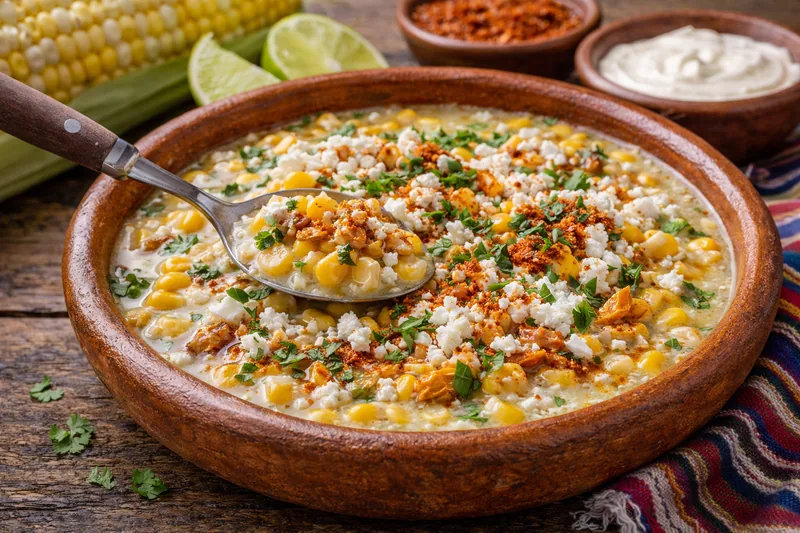
What is it?
Esquites are sweetcorn kernels cooked in broth with onion, epazote, salt and chilli, served in a cup with mayonnaise, cotija or fresh cheese, chilli powder and lime. They are one of the most popular street snacks in Mexico City and central Mexico, sold from street carts from dusk onwards.
The word esquite comes from the Nahuatl izquitl, meaning "toasted" or "toasted maize". Although today they are made boiled, their original name alludes to the pre-Hispanic technique of toasting them on a comal. Together with corn in a cup and the grilled corn cob, they make up the trilogy of Mexican "street corn", reproduced today in food trucks and restaurants around the world under the name "Mexican street corn".
Origin and history
Esquites have a documented pre-Hispanic origin. Sixteenth-century chroniclers such as Friar Bernardino de Sahagun and Juan de Torquemada mention izquitl, toasted maize, among the foods and offerings of the Mexica. The version boiled with epazote, as we know it today, is more recent; cheese arrived with the livestock farming introduced by the Spanish, and mayonnaise, an 18th-century French sauce, became popular in Mexico only in the 20th century. Over time they became a highly recognisable street food in Mexico City, where they are sold mainly at nightfall near bakeries, metro stations and other busy spots. In recent years "Mexican corn cups" have spread in the United States and Europe, and today they feature on the menus of Mexican restaurants outside Mexico.
Characteristic ingredients
The basic ingredients are: tender sweetcorn kernels (Zea mays, from landraces such as cacahuacintle or white maize), water, white onion, garlic, fresh epazote (essential for the characteristic aroma), salt and chilli (jalapeno or serrano for the broth). To serve, mayonnaise is added, along with crumbled cotija or fresh cheese, powdered piquin chilli or Tajin chilli, and a squeeze of lime. Regional variants: in the Sierra de Hidalgo they make esquites borrachos, stewed in pulque; in Hermosillo (Sonora) they are made sweet, with piloncillo syrup; in Tlaxcala they are toasted and sautéed with epazote and chile loco; and in San Luis Potosí they are known as trolelotes. Modern versions include esquites with bone marrow, chamoy or pork crackling. In many places the two names are used interchangeably; where they are distinguished, corn in a cup has the kernels straight from the cooking water with no extra broth; esquites are served with their own concentrated broth at the bottom.
Cultural significance
Esquites are one of the most representative street snacks of central Mexico. They are popular food par excellence: they cost between 20 and 50 pesos from mobile carts and are the livelihood of many "esquitero" street vendors in Mexico City, Puebla, Toluca and Cuernavaca.
Related recipes
Now that you know what it is, try cooking it at home with our step-by-step recipes:



Ingredients to cook it
Find where to buy authentic ingredients in Mexican shops in the UK:
Where to try it
Prefer to eat out? Discover authentic Mexican restaurants across the UK.
Explore Mexican restaurantsMore guides in this category
- Flautas: what they are and how to make golden taquitos
- Fried quesadillas: what they are, fillings and recipe
- Gorditas: what they are, how to make them and fillings
- Green enchiladas: what they are, what's in them and recipe
- Jocoque: what it is, what it tastes like and what to substitute for it
- Mexican tostadas: what they are, toppings and how to eat them
Frequently asked questions
- What is the difference between esquites and corn in a cup?
- Corn in a cup has the kernels taken straight from the cooking water and is served with mayonnaise, cheese, chilli and lime. Esquites are cooked in a concentrated broth with epazote, onion and chilli, and are served with that broth at the bottom of the cup. Esquites have a more herbal, brothy flavour.
- Why are they called esquites?
- The name comes from the Nahuatl izquitl, meaning "toasted" or "toasted maize". Although today they are made boiled, the name alludes to the original pre-Hispanic technique of toasting the kernels on a clay comal, mentioned by 16th-century chroniclers.
- Are esquites vegan?
- The traditional street version is not, because it contains mayonnaise, cheese and sometimes butter. However, they are easy to veganise: the mayonnaise is replaced with a vegan one (made from aquafaba or soya), the cheese with a plant-based one or nutritional yeast, and the epazote, chilli, lime and salt are kept. The base flavour is identical.
- What chilli is used for esquites?
- In the broth they are cooked with fresh jalapeno or serrano chilli. To serve, powdered piquin chilli, Tajin chilli or ground chile de arbol is sprinkled on top. In Tlaxcala they are made with strips of chile loco. The heat is adjusted to taste, and they are always finished with lime to balance.
Sources
Founder, Recetas Mexas
Mexican from Puebla, IT professional and foodie. Author of 1000+ authentic Mexican recipes adapted for home kitchens worldwide. Based in Madrid since 2018.
Read moreEnjoyed this?
Follow on TikTok for Mexican recipe & restaurant videos, and get updates by email.