Esquites: what they are, history and the street-corn-in-a-cup recipe

Edmond Bojalil · Founder, Recetas Mexas
Updated: 3 Sept 2026
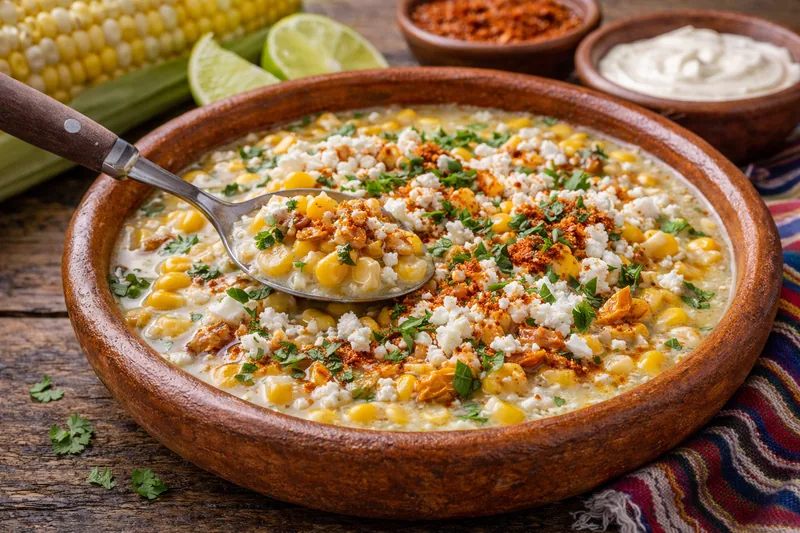
What is it?
Esquites are a preparation of sweetcorn kernels cooked in broth with onion, epazote, salt and chilli, served in a cup or small bowl with mayonnaise, crumbled cotija or fresh cheese, chilli powder and a squeeze of lime. They are one of the most popular street snacks in Mexico City and central Mexico, sold from mobile carts from dusk onwards in squares, parks and markets. The word esquite comes from the Nahuatl izquitl, meaning "toasted" or "toasted maize". Although today they are made boiled, their original name alludes to the pre-Hispanic technique of toasting them on a comal. Together with corn in a cup and the grilled corn cob, they make up the trilogy of Mexican "street corn", reproduced today in food trucks and restaurants around the world under the name "Mexican street corn".
Origin and history
Esquites have a documented pre-Hispanic origin. In the Florentine Codex, Friar Bernardino de Sahagun describes izquitl as an Aztec dish of maize kernels toasted on a comal, eaten with chilli and salt in the markets of Tlatelolco and Tenochtitlan. The version boiled in epazote broth, as we know it today, became established in central Mexico during the viceroyalty, when indigenous cooking adopted broth as a culinary vehicle and mayonnaise and cheese arrived with European influence to enrich them. By the late 19th and early 20th century, esquites were already an identifiable street food in Mexico City, especially in the Historic Centre and working-class neighbourhoods such as Tepito and La Merced. In the 2010s they underwent a media phenomenon similar to that of birria: "Mexican corn cups" went viral in the United States and Europe, and today they feature on the menus of Mexican restaurants in New York, Los Angeles, Madrid and Tokyo.
Characteristic ingredients
The basic ingredients are: tender sweetcorn kernels (Zea mays, cacahuazintle or white variety), water, white onion, garlic, fresh epazote (essential for the characteristic aroma), salt and chilli (jalapeno or serrano for the broth). To serve, mayonnaise is added, along with crumbled cotija or fresh cheese, powdered piquin chilli or Tajin chilli, and a squeeze of lime. Regional variants: in Tlaxcala and Puebla black beans or broad beans are added; in Guanajuato they are served with chiltepin chilli; in Yucatan with cotija cheese and habanero chilli; and in the United States an "esquites elote" circulates with melted butter and parmesan cheese. Modern versions include esquites with bone marrow, chamoy or pork crackling. The difference between esquites and corn in a cup is subtle: corn in a cup has the kernels straight from the cooking water with no extra broth; esquites are served with their own concentrated broth at the bottom.
Cultural significance
Esquites are one of the most representative street snacks of central Mexico and are part of traditional Mexican cuisine, inscribed by UNESCO in 2010 as Intangible Cultural Heritage. They are popular food par excellence: they cost between 20 and 50 pesos from mobile carts and represent a fundamental income for thousands of "esquitero" street vendors in Mexico City, Puebla, Toluca and Cuernavaca. In 2018 social media controversies erupted over the correct order of the ingredients (mayonnaise before or after the cheese?) and over the legitimacy of Tajin versus traditional piquin chilli. Mexico City's Culture Ministry has documented esquiteros as part of the capital's intangible gastronomic heritage. In the United States, "esquites in a cup" have been reviewed by The New York Times, Bon Appetit and Eater as one of the most successful Mexican snacks of the last decade, alongside grilled corn and chamoyadas.
Related recipes
Now that you know what it is, try cooking it at home with our step-by-step recipes:




Ingredients to cook it
Find where to buy authentic ingredients in Mexican shops in the US:
Frequently asked questions
- What is the difference between esquites and corn in a cup?
- Corn in a cup has the kernels taken straight from the cooking water and is served with mayonnaise, cheese, chilli and lime. Esquites are cooked in a concentrated broth with epazote, onion and chilli, and are served with that broth at the bottom of the cup. Esquites have a more herbal, brothy flavour.
- Why are they called esquites?
- The name comes from the Nahuatl izquitl, meaning "toasted" or "toasted maize". Although today they are made boiled, the name alludes to the original pre-Hispanic technique of toasting the kernels on a clay comal, described by Sahagun in the 16th century in the Florentine Codex.
- Are esquites vegan?
- The traditional street version is not, because it contains mayonnaise, cheese and sometimes butter. However, they are easy to veganise: the mayonnaise is replaced with a vegan one (made from aquafaba or soya), the cheese with a plant-based one or nutritional yeast, and the epazote, chilli, lime and salt are kept. The base flavour is identical.
- What chilli is used for esquites?
- In the broth they are cooked with fresh jalapeno or serrano chilli. To serve, powdered piquin chilli, Tajin chilli or ground chile de arbol is sprinkled on top. The spicier versions in Tlaxcala and Guanajuato use chiltepin. The heat is adjusted to taste, and they are always finished with lime to balance.
Sources
- México Desconocido — Esquites: origen e historia
- Larousse Cocina — Esquites
- Gobierno de México — Elote y esquites en la cocina prehispánica
Founder, Recetas Mexas
Mexican from Puebla, IT professional and foodie. Author of 1000+ authentic Mexican recipes adapted for home kitchens worldwide. Based in Madrid since 2018.
Read moreEnjoyed this?
Follow on TikTok for Mexican recipe & restaurant videos, and get updates by email.